
TL;DR
Most casino marketing teams jump from idea to execution with nothing in between, and at 15 to 20 programs a month, the cost of that gap adds up fast. A one-page campaign brief with 10 fields forces the team to agree on the objective, the audience, the message, and the success metric before any work starts. The result is fewer revisions, faster creative development, and programs that start from clarity instead of assumptions.
Someone says “we need a slot tournament.” The next conversation is about the email subject line. Or the flyer design. Or whether the free play amount should be $25 or $50.
The team jumps from idea to execution with nothing in between. No agreement on the objective. No clarity on who the promotion is for. No definition of what success looks like.
It works often enough that nobody questions it. Until the campaign underperforms and nobody can explain why. Until the designer delivers something that misses the mark and has to start over. Until two people on the team have completely different ideas about what the promotion was supposed to accomplish.
And sometimes the opposite happens. The team is running so many programs that they default to repeating what they did last time. Same creative, same offer, same everything. It feels efficient until someone in the room decides they’re tired of seeing the same thing and wants something new. Now the team is revising work they thought was done, for reasons that were never expressed, because there was no documentation where that conversation would have happened before creative started.
If there are 30 days in a month, your department is probably running 15 to 20 programs plus core and supplemental mailers. At that volume, the gap between “we need a promotion” and “start building the email” is where most of the wasted time, wasted revisions, and wasted budget in casino marketing lives.
The fix is one page. A campaign brief.
Not a 12-page creative brief. Not an agency-style document that feels like it takes longer to write than the campaign takes to execute. That’s a formula for nonadoption. One page that forces your team to answer the questions that matter before any work starts.
What a Campaign Brief Actually Is (and Why Casino Marketing Teams Need One)
Strip away the agency connotation. A campaign brief is a short, structured agreement between the person requesting work and the person doing it. It answers the foundational questions: What are we trying to accomplish? Who are we trying to reach? What’s the message? How will we know it worked?
For a marketing director running a lean team, the brief is a decision filter. It keeps you from greenlighting campaigns without a clear purpose, and it keeps your team from spending a week building something that should have been a different conversation entirely.
For a coordinator or specialist executing the work, the brief is clarity. It defines what “done” looks like before the first draft, the first design, the first email build. That’s the difference between confident execution and educated guessing.
For your in-house designer or creative vendor, the brief is a lifeline. Designers in regional casino marketing departments get pulled in a dozen directions every week. Signage, digital ads, email headers, social graphics, direct mail, event collateral. When direction for any of those projects comes from a hallway conversation or a two-line email, the designer fills in the gaps with assumptions. And assumptions lead to revisions. Round after round of “that’s not quite what I had in mind” that could have been avoided if someone had written down what they had in mind before the first proof.
I’ve worked with in-house creative briefs that were four pages long. The result was predictable: 60% of the fields were left blank, or people copied the previous document and changed the promotion name in the filename. A four-page brief is a form nobody fills out. A one-page brief is a conversation that takes 20 minutes and saves hours.
One page. Reviewed, discussed, approved. Then the creative work starts.
Why Small Teams Need This More, Not Less
The instinct on a lean team is to skip the brief. You all sit in the same office. You all know the property. You don’t have time for another piece of paperwork when you’re running 15 to 20 programs a month with three people.
That instinct is backwards.
A team running that kind of volume without a repeatable starting point is a team that reinvents the wheel every time. Every campaign begins from scratch. Every decision is made on instinct instead of intention. Every post-mortem (if there even is one) starts with “what were we trying to do?” because nobody wrote it down.
Small teams lose more time to miscommunication, rework, and post-campaign confusion than the brief ever costs to fill out. Twenty minutes before brainstorming starts can save hours of revision, confusion, and the kind of late-night “this isn’t right” email that makes everyone question whether the campaign was worth running in the first place.
The team with 15 people and dedicated project managers has systems to catch misalignment. Your team of three does not. The brief is that system.
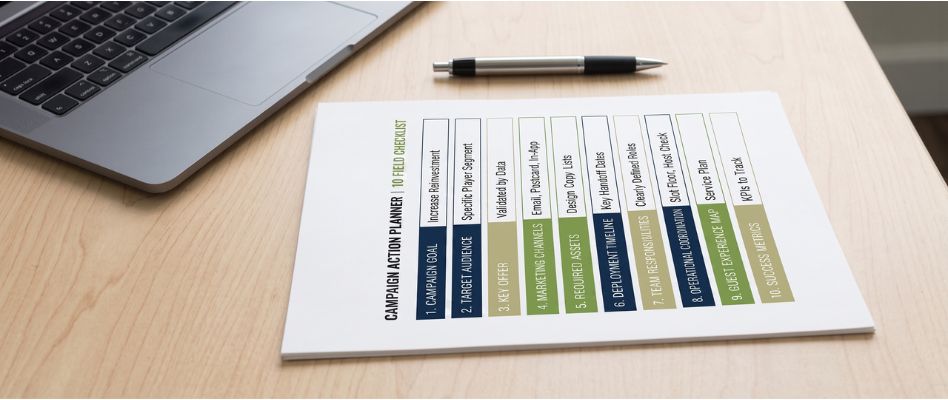
The Campaign Brief: 10 Fields, One Page
Here’s the framework. These fields work for a direct mail campaign, an ad, a slot tournament, a dining promotion, a concert push, or a monthly free play offer. The format stays the same. The answers change.
Campaign Name
Give it a name so everyone is talking about the same thing. “Slot tournament” is a format. “High Life Spin-Off” is a campaign. A clear, specific name prevents the confusion that happens when three people are working on the same promotion and calling it three different things.
Objective
What guest behavior are you trying to drive? Not “awareness.” Not “engagement.” A verb tied to a measurable action. Increase visits from lapsed mid-tier guests. Drive trial of the new restaurant among players club members. Fill 200 seats for the Saturday concert. If you can’t state the objective in one sentence, the campaign isn’t ready to build yet.
Every program needs a job. If you can’t name the job before you start building, the brief just told you something important.

Target Segment
Who specifically? “Our players” is not a segment. Which tier? Which behavior pattern? Which lifecycle stage? Are you talking to your best weekly visitors, your monthly guests who used to come more often, or new sign-ups who haven’t made a second visit? The answer changes everything about the offer, the message, and the channel.
Key Message
One sentence. If the guest remembers one thing from this program, what is it? This forces you to prioritize. When a campaign tries to communicate five things at once, it communicates nothing. One clear message that connects the offer to the reason the guest should care.
Offer or Value Proposition
What is the guest getting? Free play, drawing entries, a dining credit, a room offer, early access to an event? And why should they care enough to act? The offer needs to match the objective. If the goal is reactivation, a $10 free play offer sent to a guest who hasn’t visited in six months probably won’t change behavior.
Channels and Tactics
Where will the communications campaign live? Email, SMS, direct mail, social, on-property signage, digital screens, host outreach? Decide this before creative starts, not after. Each channel has different format requirements, different timelines, and different audience expectations. A designer who knows the deliverables up front can plan the work. A designer who learns about the direct mail piece after they’ve already built the email template is starting over.
Timeline
Promotion start and end dates. Regulatory review. Creative deadline. Approval checkpoint. Send dates or deployment dates for each channel. Print deadlines if direct mail is involved. All of it, on the brief, before anyone starts building. The timeline is where “we need this by Friday” either gets validated or renegotiated. Both of those outcomes are better than discovering the timeline is impossible after the work is halfway done.
Budget
What’s allocated? What’s the reinvestment commitment? What are the hard costs for printing, postage, media, entertainment, food and beverage? Knowing the budget before creative development prevents the conversation nobody wants to have: “We love this idea, but we can’t afford it.” Said after the designer has already built it, the copy has been written, and the mail file has been pulled.
Success Metrics
How will you know this program worked? Define this before launch, not after. Visits, incremental revenue, redemption rate, response rate, attendance, cost per acquisition, return on investment. Pick the metric that matches the objective you wrote at the top of the brief. If your objective is to increase visits from lapsed guests and your success metric is email open rate, there’s a disconnect. The brief makes that disconnect visible before it becomes a problem.
Approvals
Who needs to sign off, and by when? The GM? The players club manager? Compliance? Finance? Name them and set the deadline. This single field eliminates an entire category of last-minute chaos: the campaign that’s ready to deploy but sitting in someone’s inbox waiting for a signature nobody asked for until the day before launch.
A downloadable one-page version of this brief is available in the Casino Marketing Boot Camp resources hub.
How to Make the Campaign Brief a Team Habit
A brief that gets filled out once and forgotten doesn’t change anything. The brief has to become a habit. Part of how the team starts every campaign, not a special occasion exercise.
Fill it out together the first few times. Sit with your team and walk through the fields for an upcoming campaign. The conversation that happens during the fill-in is as valuable as the document itself. You’ll discover disagreements about the objective, gaps in the timeline, and assumptions about the audience that would have surfaced as problems later. Better to find them in a 20-minute meeting than in a revision cycle.
Keep the brief visible. Not buried in a shared drive folder nobody opens. Pinned in whatever tool your team uses to manage work. Referenced in the kickoff conversation. Pulled out again during the campaign recap. And before the email goes out, a quick pre-send check confirms the message matches the brief.
Brief the designer from the brief. When creative work is needed, the brief is what travels. Not a verbal description. Not a forwarded email chain. Not “make it look like what we did last time but different.” The designer gets the brief, reads the objective, the audience, the message, and the channels, and starts working from clarity instead of interpretation. One round of revisions because of a genuine creative choice is normal. Three rounds because the direction was never clear is a systems failure the brief exists to prevent.
Use the brief to manage inbound requests. This is where it earns its keep.
Every marketing director in a regional casino knows this pattern. The players club needs a flyer for a new promotion. F&B wants help promoting a new menu item. The entertainment team wants “something on social” for a concert they’re just now mentioning even though it’s three weeks out. The hotel team has a rate special they forgot to tell you about.
Those requests show up with almost no information. Marketing builds something based on assumptions. The requesting department says “that’s not what I meant.” The revision cycle eats the week.
The brief flips that dynamic. When a department brings a request, they fill out the brief. “Tell me the objective, the audience, the message, and the timeline, and I’ll get your project scheduled.” You’re protecting your team’s time and the quality of the output. The brief puts the thinking where it belongs: on the person making the request, before creative starts. Not on the marketing team after three rounds of revisions and a missed deadline.
Then share the completed brief outward. Send it to the players club so they can answer guest questions about the promotion. Send it to operations so they can plan staffing for the event. Include it in your approval request to the GM so he sees the objective, the segment, and the success metric in one clean document instead of getting a verbal pitch between meetings.
The brief becomes your single source of truth. It goes to the designer, to the other departments, to leadership. Everyone works from the same page because there is one page.
Who specifically? “Our players” is not a segment. Which tier? Which behavior pattern? Which lifecycle stage? Are you talking to your best weekly visitors, your monthly guests who used to come more often, or new sign-ups who haven’t made a second visit? The answer changes everything about the offer, the message, and the channel.
Key Message
One sentence. If the guest remembers one thing from this program, what is it? This forces you to prioritize. When a campaign tries to communicate five things at once, it communicates nothing. One clear message that connects the offer to the reason the guest should care.
Offer or Value Proposition
What is the guest getting? Free play, drawing entries, a dining credit, a room offer, early access to an event? And why should they care enough to act? The offer needs to match the objective. If the goal is reactivation, a $10 free play offer sent to a guest who hasn’t visited in six months probably won’t change behavior.
Channels and Tactics
Where will the communications campaign live? Email, SMS, direct mail, social, on-property signage, digital screens, host outreach? Decide this before creative starts, not after. Each channel has different format requirements, different timelines, and different audience expectations. A designer who knows the deliverables up front can plan the work. A designer who learns about the direct mail piece after they’ve already built the email template is starting over.
Timeline
Promotion start and end dates. Regulatory review. Creative deadline. Approval checkpoint. Send dates or deployment dates for each channel. Print deadlines if direct mail is involved. All of it, on the brief, before anyone starts building. The timeline is where “we need this by Friday” either gets validated or renegotiated. Both of those outcomes are better than discovering the timeline is impossible after the work is halfway done.
Budget
What’s allocated? What’s the reinvestment commitment? What are the hard costs for printing, postage, media, entertainment, food and beverage? Knowing the budget before creative development prevents the conversation nobody wants to have: “We love this idea, but we can’t afford it.” Said after the designer has already built it, the copy has been written, and the mail file has been pulled.
Success Metrics
How will you know this program worked? Define this before launch, not after. Visits, incremental revenue, redemption rate, response rate, attendance, cost per acquisition, return on investment. Pick the metric that matches the objective you wrote at the top of the brief. If your objective is to increase visits from lapsed guests and your success metric is email open rate, there’s a disconnect. The brief makes that disconnect visible before it becomes a problem.
Approvals
Who needs to sign off, and by when? The GM? The players club manager? Compliance? Finance? Name them and set the deadline. This single field eliminates an entire category of last-minute chaos: the campaign that’s ready to deploy but sitting in someone’s inbox waiting for a signature nobody asked for until the day before launch.
A downloadable one-page version of this brief is available in the Casino Marketing Boot Camp resources hub.
How to Make the Campaign Brief a Team Habit
A brief that gets filled out once and forgotten doesn’t change anything. The brief has to become a habit. Part of how the team starts every campaign, not a special occasion exercise.
Fill it out together the first few times. Sit with your team and walk through the fields for an upcoming campaign. The conversation that happens during the fill-in is as valuable as the document itself. You’ll discover disagreements about the objective, gaps in the timeline, and assumptions about the audience that would have surfaced as problems later. Better to find them in a 20-minute meeting than in a revision cycle.
Keep the brief visible. Not buried in a shared drive folder nobody opens. Pinned in whatever tool your team uses to manage work. Referenced in the kickoff conversation. Pulled out again during the campaign recap. And before the email goes out, a quick pre-send check confirms the message matches the brief.
Brief the designer from the brief. When creative work is needed, the brief is what travels. Not a verbal description. Not a forwarded email chain. Not “make it look like what we did last time but different.” The designer gets the brief, reads the objective, the audience, the message, and the channels, and starts working from clarity instead of interpretation. One round of revisions because of a genuine creative choice is normal. Three rounds because the direction was never clear is a systems failure the brief exists to prevent.
Use the brief to manage inbound requests. This is where it earns its keep.
Every marketing director in a regional casino knows this pattern. The players club needs a flyer for a new promotion. F&B wants help promoting a new menu item. The entertainment team wants “something on social” for a concert they’re just now mentioning even though it’s three weeks out. The hotel team has a rate special they forgot to tell you about.
Those requests show up with almost no information. Marketing builds something based on assumptions. The requesting department says “that’s not what I meant.” The revision cycle eats the week.
The brief flips that dynamic. When a department brings a request, they fill out the brief. “Tell me the objective, the audience, the message, and the timeline, and I’ll get your project scheduled.” You’re protecting your team’s time and the quality of the output. The brief puts the thinking where it belongs: on the person making the request, before creative starts. Not on the marketing team after three rounds of revisions and a missed deadline.
Then share the completed brief outward. Send it to the players club so they can answer guest questions about the promotion. Send it to operations so they can plan staffing for the event. Include it in your approval request to the GM so he sees the objective, the segment, and the success metric in one clean document instead of getting a verbal pitch between meetings.
The brief becomes your single source of truth. It goes to the designer, to the other departments, to leadership. Everyone works from the same page because there is one page.
Who specifically? “Our players” is not a segment. Which tier? Which behavior pattern? Which lifecycle stage? Are you talking to your best weekly visitors, your monthly guests who used to come more often, or new sign-ups who haven’t made a second visit? The answer changes everything about the offer, the message, and the channel.
Key Message
One sentence. If the guest remembers one thing from this program, what is it? This forces you to prioritize. When a campaign tries to communicate five things at once, it communicates nothing. One clear message that connects the offer to the reason the guest should care.
Offer or Value Proposition
What is the guest getting? Free play, drawing entries, a dining credit, a room offer, early access to an event? And why should they care enough to act? The offer needs to match the objective. If the goal is reactivation, a $10 free play offer sent to a guest who hasn’t visited in six months probably won’t change behavior.
Channels and Tactics
Where will the communications campaign live? Email, SMS, direct mail, social, on-property signage, digital screens, host outreach? Decide this before creative starts, not after. Each channel has different format requirements, different timelines, and different audience expectations. A designer who knows the deliverables up front can plan the work. A designer who learns about the direct mail piece after they’ve already built the email template is starting over.
Timeline
Promotion start and end dates. Regulatory review. Creative deadline. Approval checkpoint. Send dates or deployment dates for each channel. Print deadlines if direct mail is involved. All of it, on the brief, before anyone starts building. The timeline is where “we need this by Friday” either gets validated or renegotiated. Both of those outcomes are better than discovering the timeline is impossible after the work is halfway done.
Budget
What’s allocated? What’s the reinvestment commitment? What are the hard costs for printing, postage, media, entertainment, food and beverage? Knowing the budget before creative development prevents the conversation nobody wants to have: “We love this idea, but we can’t afford it.” Said after the designer has already built it, the copy has been written, and the mail file has been pulled.
Success Metrics
How will you know this program worked? Define this before launch, not after. Visits, incremental revenue, redemption rate, response rate, attendance, cost per acquisition, return on investment. Pick the metric that matches the objective you wrote at the top of the brief. If your objective is to increase visits from lapsed guests and your success metric is email open rate, there’s a disconnect. The brief makes that disconnect visible before it becomes a problem.
Approvals
Who needs to sign off, and by when? The GM? The players club manager? Compliance? Finance? Name them and set the deadline. This single field eliminates an entire category of last-minute chaos: the campaign that’s ready to deploy but sitting in someone’s inbox waiting for a signature nobody asked for until the day before launch.
A downloadable one-page version of this brief is available in the Casino Marketing Boot Camp resources hub.
How to Make the Campaign Brief a Team Habit
A brief that gets filled out once and forgotten doesn’t change anything. The brief has to become a habit. Part of how the team starts every campaign, not a special occasion exercise.
Fill it out together the first few times. Sit with your team and walk through the fields for an upcoming campaign. The conversation that happens during the fill-in is as valuable as the document itself. You’ll discover disagreements about the objective, gaps in the timeline, and assumptions about the audience that would have surfaced as problems later. Better to find them in a 20-minute meeting than in a revision cycle.
Keep the brief visible. Not buried in a shared drive folder nobody opens. Pinned in whatever tool your team uses to manage work. Referenced in the kickoff conversation. Pulled out again during the campaign recap. And before the email goes out, a quick pre-send check confirms the message matches the brief.
Brief the designer from the brief. When creative work is needed, the brief is what travels. Not a verbal description. Not a forwarded email chain. Not “make it look like what we did last time but different.” The designer gets the brief, reads the objective, the audience, the message, and the channels, and starts working from clarity instead of interpretation. One round of revisions because of a genuine creative choice is normal. Three rounds because the direction was never clear is a systems failure the brief exists to prevent.

Use the brief to manage inbound requests. This is where it earns its keep.
Every marketing director in a regional casino knows this pattern. The players club needs a flyer for a new promotion. F&B wants help promoting a new menu item. The entertainment team wants “something on social” for a concert they’re just now mentioning even though it’s three weeks out. The hotel team has a rate special they forgot to tell you about.
Those requests show up with almost no information. Marketing builds something based on assumptions. The requesting department says “that’s not what I meant.” The revision cycle eats the week.
The brief flips that dynamic. When a department brings a request, they fill out the brief. “Tell me the objective, the audience, the message, and the timeline, and I’ll get your project scheduled.” You’re protecting your team’s time and the quality of the output. The brief puts the thinking where it belongs: on the person making the request, before creative starts. Not on the marketing team after three rounds of revisions and a missed deadline.
Then share the completed brief outward. Send it to the players club so they can answer guest questions about the promotion. Send it to operations so they can plan staffing for the event. Include it in your approval request to the GM so he sees the objective, the segment, and the success metric in one clean document instead of getting a verbal pitch between meetings.
The brief becomes your single source of truth. It goes to the designer, to the other departments, to leadership. Everyone works from the same page because there is one page.
For the Coordinator Who Wants to Grow
If you’re the person on the team who builds the email, pulls the list, and prints the signage, the brief is more than a project management tool. It’s a professional development tool.
Every time you fill out a brief, you’re practicing the thinking that separates execution from leadership. You’re asking “why are we doing this?” before “what should I build?” You’re connecting the campaign to a business objective instead of just getting it out the door. You’re learning to define success before launch instead of hoping for good results after.
Own the brief on your team. Volunteer to fill it out. Ask the questions it forces you to ask. When you can walk into a meeting and say “the objective for this campaign is to increase mid-tier visits by 15% over last month, and here’s how we’ll measure it,” you’re not checking boxes. You’re leading.
That’s how coordinators become directors. Not by working more hours on execution, but by learning to think about the work before the work starts.
Key Takeaways
- A campaign brief is a one-page agreement on the objective, audience, message, and success metric, filled out before any creative work begins.
- At 15 to 20 programs per month, small casino marketing teams lose more time to rework and miscommunication than the brief costs to fill out.
- A four-page brief is a form nobody fills out. One page is the threshold that separates adoption from nonadoption.
- Every program needs a job. If you can’t name the objective in one sentence, the program is not ready to build.
- The brief is also a defensive tool: when other departments bring vague requests, the brief puts the thinking where it belongs, on the person making the request.
- The brief is the “before.” The campaign recap is the “after.” Together they close the loop between intention and outcome.
The Brief Is the “Before”
The brief tells you what you set out to do. The campaign recap tells you whether you did it. Together, they close the loop that most casino marketing teams never close: the connection between intention and outcome.
The brief is the starting discipline. What comes after it is the accountability discipline. And that’s a conversation worth having next.
FAQs
What should a casino marketing campaign brief include?
A campaign brief for a casino marketing team should include 10 fields: campaign name, objective, target segment, key message, offer or value proposition, channels and tactics, timeline, budget, success metrics, and approvals. Each field should be answerable in one to two sentences. The entire brief should fit on one page.
Why do small casino marketing teams need a campaign brief?
Small teams running 15 to 20 programs per month lose significant time to miscommunication, rework, and unclear objectives. The brief forces alignment before creative work starts, which prevents the revision cycles that cost more time than the brief itself. Teams with dedicated project managers have systems to catch misalignment. A team of three does not. The brief is that system.
How is a campaign brief different from a creative brief?
A creative brief is typically a multi-page document focused on design and messaging direction for a creative agency or design team. A campaign brief is broader and simpler. It covers the full program: objective, audience, offer, channels, timeline, budget, metrics, and approvals. For a lean casino marketing team without an agency partner, the campaign brief is the only planning document most programs need.
How do you get other casino departments to use the campaign brief?
When another department brings a vague request, hand them the brief. “Tell me the objective, the audience, the message, and the timeline, and I’ll get your project scheduled.” This puts the thinking on the person making the request before creative starts, which reduces revision cycles and protects the marketing team’s time. Once complete, the same brief can be shared back to the requesting department so they can answer guest questions and plan their own operations around the program.
How do you measure whether a casino promotion worked?
Define the success metric before launch, not after. The metric should match the objective stated in the brief. If the objective is to increase visits from lapsed mid-tier guests, the success metric is visits or trip frequency, not email open rate. Common metrics for casino promotions include visits, incremental revenue, redemption rate, response rate, attendance, and return on investment.
What is the most common mistake casino marketing teams make when planning campaigns?
The most common mistake is jumping from idea to execution without agreeing on the objective, the target segment, or how success will be measured. This leads to campaigns that feel busy but cannot be evaluated, creative that misses the mark because direction was never documented, and revision cycles that consume the team’s week. A one-page campaign brief eliminates this gap.
Julia Carcamo is a casino marketing strategist and founder of Casino Marketing Boot Camp, an intensive training program built specifically for casino marketers. She has spent her career helping regional and tribal operators turn brand strategy into practical, measurable action. Ready to level up your marketing? Explore the upcoming Casino Marketing Boot Camp events.
Recent Comments