TL;DR
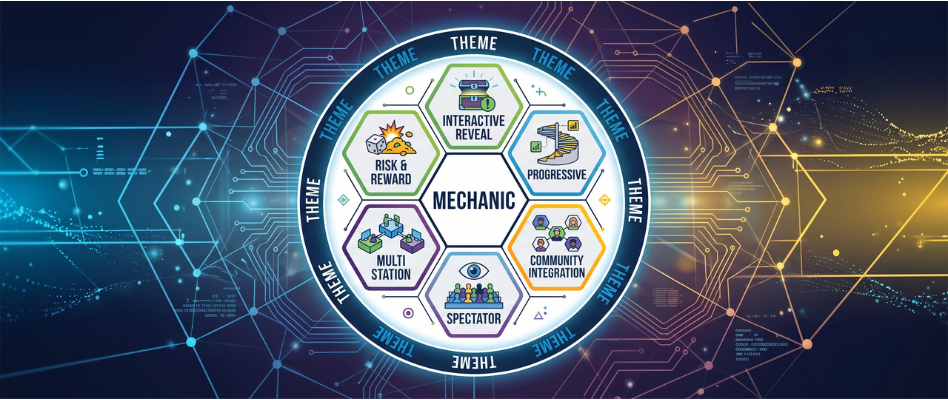
The difference between a drawing guests forget and an event they talk about has nothing to do with the theme. It comes down to the underlying mechanic. These are six structural moves that change how guests experience a promotion, regardless of season, budget, or property size. Each one shifts a guest’s role from passive recipient to active participant, and each is something a lean team can execute without a production company on speed dial.
Why the Mechanic Matters More Than the Theme
Every casino marketing team has been here: you run a promotion with a great theme, a generous prize pool, and decent attendance, but afterward nobody remembers it. Then you run something on a fraction of the budget, and guests are still talking about it weeks later.
The difference rarely comes down to the theme. It comes down to the structure of the experience. Specifically, what the guest is asked to do, decide, or feel during the event.
A mechanic is the structural backbone of a promotion. It’s what creates emotional engagement. Theme is the wrapper. You can wrap any mechanic in any theme: a harvest festival, a Hollywood awards night, a space mission, a county fair. The theme gives it personality. The mechanic gives it energy.
Understanding the difference lets your team stop reinventing the wheel every quarter. Instead of brainstorming new promotion ideas from scratch, you can choose a mechanic that corresponds to your goal (or has known success) and dress it in a theme that fits your property and calendar. That shift alone saves time and delivers better results.
Here are six mechanics worth knowing. Each one works independently of theme. Each one is something a lean team can execute on a reasonable budget, with a willingness to focus on structure over decoration.
The Interactive Reveal
What It Is
Guests actively discover what they’ve won rather than passively receiving a prize. They choose an envelope from a wall, pick from a set of identical containers, open a crate, or select a prop from a display. The discovery moment is theirs.
Why It Works
Standard drawings announce a name and hand someone a check. The guest’s role is to stand there. An interactive reveal puts the guest in motion. They make a choice. They anticipate. They experience the few seconds between choosing and discovering. That gap, between “I picked this one” and “let me see what’s inside,” is where the emotion lives.
It also shifts the experience from backward-facing to forward-facing. A standard drawing says, “We watched your play, and you qualified.” An interactive reveal asks, “What will you find?” One rewards past behavior. The other creates a present-tense moment.
How It Changes Guest Behavior
Guests who participate in the reveal remember the promotion. They don’t just remember winning or losing. They remember the moment of choosing. That memory is what they share with a friend, a spouse, or a co-worker when they recount the visit. It turns the promotion from a transaction into a story.
How to Execute It
The reveal can be as simple as numbered envelopes on a wall or as elaborate as custom-built props. The key is that every option looks identical on the outside so the choice feels real. If guests can see or guess which option holds the biggest prize, the mechanic collapses. Pre-assign prizes to each option before the event begins, and don’t change them. The integrity of the choice is the entire point.
Consider how the reveal will read to the room, not just the winner. If the reveal happens behind a curtain or at a desk, only the winner experiences it. If it happens on a stage or in front of a crowd, everyone in the venue shares in the anticipation. That shared experience is free. Build for it.
The Risk/Reward Decision
What It Is
After winning something, the guest faces a choice: keep what they have or gamble it for a chance at something bigger. The guest controls the outcome. The audience watches.
Why It Works
This mechanic draws on the same psychology that makes gaming engaging: the tension between a guaranteed outcome and an uncertain one. But in a promotional context, it adds something gaming doesn’t have—an audience. When a guest stands onstage deciding whether to keep $2,000 or trade it for what’s behind a door, everyone in the room becomes a participant. They cheer. They groan. They shout advice. The spectators are part of the event, whether they win anything or not.
The risk/reward mechanic also creates natural drama without any additional production. You don’t need a script. You don’t need a host who’s a trained entertainer. The tension creates itself the moment the guest must decide.
How It Changes Guest Behavior
Guests talk about the decisions. “I kept it.” “She traded and won $5,000.” “He traded and lost everything.” These stories travel between visits. They become the currency of word-of-mouth, carrying your casino’s name with them.
How to Execute It
The balance matters. If the “gamble” option is almost always better, word gets around, and the tension disappears. If it’s almost always worse, guests stop gambling, and the mechanic becomes a formality. Design the prize distribution so that keeping and gambling both produce good stories at roughly the same rate.
One important lesson from the field, shared by Chris Province, Founder of Player Performance Group and a Casino Marketing Boot Camp coach: a property ran a guaranteed-amount-versus-scratch-for-more mechanic, allowing guests to see their guaranteed prize before deciding whether to scratch for a potentially larger one. For lower-tier players, seeing a low guaranteed amount suppressed participation. They saw the small amount and didn’t bother. The fix was to remove the stated guarantee and offer multiple prize options instead, which reduced volatility while preserving the risk/reward tension.

The takeaway: how you frame the choice shapes behavior. Don’t assume that showing the “safe” option makes the decision more interesting. Sometimes it shuts down the decision entirely.
The Passport / Multi-Station Experience
What It Is
Instead of a single-moment event, guests move through multiple touchpoints and build something along the way. A passport they collect stamps in. A tote they fill at different stations. A card they get punched at each stop. The event is a journey with multiple chapters, not a single scene.
Why It Works
Single-moment promotions have one peak: the drawing. Everything before is waiting. Everything after is leaving. A multi-station experience spreads engagement across the entire event. Each station is its own small experience, interaction, and decision. Guests stay longer because there’s always a next stop.
It also creates natural movement throughout the property. If the stations are located in different areas, guests walk through areas they might not otherwise visit. If different staff members or partners staff the stations, guests have multiple positive interactions with people rather than a single interaction with a microphone.
How It Changes Guest Behavior
Extended dwell time during an event may translate into less floor time. But the bigger behavioral shift is in how guests perceive the event. A single-moment promotion feels like something that happened to them, whereas a multi-station experience feels like something they did. That distinction matters for memory, satisfaction, and whether they tell someone else about it.
How to Execute It
Each station needs to feel complete on its own. If a station is just a checkpoint where someone stamps a card, it feels like a chore. If the station offers a choice, a taste, a brief interaction, or a discovery, it’s an experience. The passport or collection mechanic is the connective tissue, but the stations are the content.
Keep the total number of stations manageable. Five is the sweet spot. Seven is the ceiling. Beyond that, guests start to feel like they’re running errands instead of enjoying the event.
Give each station a physical tracking mechanism, such as a stamp, a sticker, or a tab torn from the passport. This serves two purposes: inventory reconciliation for your team and a tangible sense of progress for the guest. When guests can see how many stations they’ve completed, the collection instinct kicks in. Nobody wants to leave with an incomplete passport.
If your multi-station experience includes curated gifts or physical items that guests collect at each stop, the design of those items and how they complement one another is its own discipline. That’s the territory of anchor gifts and continuity program design, which we’ll cover in a companion post.
The Progressive Element
What It Is
A prize or jackpot that accumulates progressively if it isn’t won. Each drawing in which the top prize goes unclaimed increases the prize for the next drawing. The promotion becomes a multi-week narrative with escalating stakes.
Why It Works
A progressive creates something that almost no other promotion mechanic does: a reason to come back that isn’t a new offer. The running total is the reason. Guests who visit in week one and see the prize at $5,000 know it could reach $15,000 by week three. They don’t need a new mailer or a new theme. The mechanic itself drives return visits.
It also sparks conversation between visits. “Did anyone win it last Saturday?” becomes a legitimate topic among regulars. When the prize grows large enough, guests who weren’t originally planning to visit start showing up specifically for the progressive. That’s organic, earned traffic. No additional media spend required.
How It Changes Guest Behavior
Progressives shift visitation from occasion-based to narrative-based. Instead of asking “what’s happening this weekend,” guests ask “how big is it now?” That’s a fundamentally different relationship with the promotion. It also rewards frequency. Guests who visit every week feel like they’re tracking the story, not just showing up for another drawing.
How to Execute It
Two operational details can make or break a progressive.
First, set a cap. An uncapped progressive sounds exciting in theory but creates budgeting problems and can reach an amount that feels implausible to guests. A common structure sets the jackpot at $5,000, increases it by a set increment (say, $750) each time it isn’t won, and caps it at $25,000. This creates a clear growth arc while keeping the budget manageable.
Second, build a must-go into the final night. If the top prize hasn’t been won by the last scheduled event, guarantee it will be awarded that night. Chris Province’s position on this is clear and worth repeating: if you advertise a car, give away a car. The must-go reinforces trust in an industry where players already feel the game works against them. Truthfulness builds brand equity. Every time a guest sees a progressive hit its must-go and watches someone walk away with the prize, the casino’s credibility grows.
On the operational side, a well-structured must-go on the final night can generate additional revenue because guests who’ve been tracking the progressive will show up specifically for the guaranteed payout night. That’s a measurable lift built into the promotion’s structure.
Make the running total visible. Display the current jackpot amount on digital signage, your website, and in your social posts throughout the promotional period. The number is doing the marketing for you. Let it work.
The Spectator Event
What It Is
A promotion designed so that watching is almost as engaging as winning. The audience reacts, cheers, and becomes part of the energy. The event is entertainment, not simply a giveaway.
Why It Works
Most drawings are boring to watch. A name is called. Someone walks to a table. They receive something. The other 200 people in the room check their phones. A spectator event reverses that dynamic. The game, the decision, the reveal, or the physical activity creates something worth watching. When non-winners have a good time watching, they leave with a positive memory of the event, even though they didn’t win anything.
That’s a critical distinction. In a standard drawing, non-winners leave feeling like they lost. In a spectator event, non-winners leave feeling like they attended something entertaining. One breeds resentment. The other fosters affinity.
How It Changes Guest Behavior
Spectator events generate the kind of organic social content no marketing budget can buy. When a guest pulls out their phone to record another guest making a risk/reward decision on stage, that’s unprompted user-generated content featuring your casino’s logo, your staff, and your brand. Multiply that by a room full of smartphones, and you’ve turned a Saturday night promotion into a distributed advertising campaign you didn’t have to pay for.
The other behavioral shift is longer stays. Guests watching something entertaining don’t leave between drawings. They stay for the next round. And while they’re watching, they’re on the floor. That dwell time has measurable value, and your team should track it.
How to Execute It
The spectator quality doesn’t require professional production. It requires three elements: sightlines, sound, and pacing.
Can the audience see the action? Position the game area so a crowd can naturally gather around it. If only the first row can see what’s happening, the event loses its spectator energy beyond the third row.
Can they hear what’s happening? Use a mic so the host’s calls and the contestant’s reactions carry. Audio is half the drama. When the room hears the host say, “Will you keep it or risk it?” and the contestant hesitates, the entire crowd is in the moment.
Is the pacing right? If each contestant’s turn takes thirty seconds, the crowd has no time to build energy. If it takes ten minutes, the energy dissipates. Two to four minutes per contestant is the sweet spot. That’s long enough to build tension and short enough to hold attention across multiple rounds.
If your game includes a physical element too small to see from the back of the room, use a screen or monitor to display what’s happening. A life-size game board, oversized dice, or a large prop wall can solve this naturally. Scale the game components to match the audience.
The Community Integration
What It Is
Local nonprofits, artisans, or small businesses are integrated into the promotion itself, not as sponsors or as logos on a banner, but as actual participants who add texture, expertise, and connection to the event.
Why It Works
Regional casinos live and die by their relationship with the community. That relationship is either genuine or it’s just a line in a press release. When local partners are part of the event itself, they bring their own audience, credibility, and story. A local artisan running a booth at your event isn’t there because you paid them. They’re there because the event is designed to showcase what makes the community interesting.
This also creates a competitive moat. A competitor can copy your theme and match your prize pool, but they cannot replicate your relationship with the specific local businesses and organizations that make your community unique. The integration is inherently tied to place.
Why This Is a Community-Hub Play, not a Lifestyle-Marketing Play
Lifestyle marketing borrows aesthetics from culture and trends. Community integration is different. It’s not about looking like a farmers market or a festival. It’s about being one, at least for a night. The local coffee roaster isn’t a prop. They’re serving their actual product and connecting with potential customers. The nonprofit isn’t a charity-donation recipient. They’re in the room, interacting with guests and building their own relationships.
That authenticity is what makes the mechanic work and what makes it impossible to fake.
How It Changes Guest Behavior
Community-integrated events attract guests who wouldn’t normally attend a casino promotion. They come for the market, the artisans, the nonprofit, or the experience, and they play while they’re there. These events also strengthen the casino’s local identity. Guests who attend a community-integrated event begin to associate the casino with community investment, not just gaming. That association is an asset that grows over time.
How to Execute It
Choose partners who are genuinely skilled at what they do and whom your guests would be interested in meeting. Quality matters more than quantity. Three excellent local vendors create a better experience than eight mediocre ones.
Make the partner’s involvement substantive. Give them a meaningful role, real interaction, and enough time and space to represent their work well. If guests choose from a vendor’s product line, sample their goods, or participate in a demonstration, the partner becomes part of the experience rather than a decoration. If a guest votes for their favorite vendor at the end of the night, that engagement loop builds emotional investment and gives the casino useful data on what the community values.
Build relationships with these partners before and after the event. If they have a great experience, they’ll promote the event to their own audience next time. That’s reach you couldn’t buy. And if you include their business name and location in the guest’s passport or takeaway, you’ve given your guest a reason to think about the event long after they’ve left the property.
Key Takeaways
- The mechanic is what creates engagement; the theme is just the wrapper. You can change the theme every quarter without losing the structural move that makes the event work.
- Interactive reveals work because they shift the guest from receiving a prize to discovering it, creating a present-tense moment they’ll describe to someone else.
- How you frame a risk/reward choice shapes behavior. Showing the “safe” option doesn’t always make the decision more engaging; sometimes it shuts it down entirely.
- Progressives are one of the few mechanics that generate return visits without a new offer, new mailer, or new theme. The running total does the marketing for you.
- Spectator events turn non-winners into fans. When watching is almost as good as winning, every guest leaves with a positive memory of the event.
- Community integration creates a competitive moat. A competitor can copy your theme and match your prize pool, but they can’t replicate your relationships with the organizations that make your community unique.
Combining Mechanics
These six mechanics are not mutually exclusive. The most memorable casino promotions combine two or three of them in a single event. An interactive reveal paired with a spectator event. A multi-station experience with community integration. A progressive element feeding into a risk/reward finale.
The combination is where events start to feel like entertainment rather than giveaways. And that’s what guests remember, talk about, and come back for.
When you’re planning your next promotion, start with the mechanic. Decide which structural move will drive the engagement you want. Then choose a theme that fits your property and your calendar. Then execute.
Download the Promotion Mechanic Planner to bring this framework to your next planning meeting.
That sequence- mechanic first, theme second- is the discipline that separates a full calendar from a productive one.
Julia Carcamo is a casino marketing strategist and founder of Casino Marketing Boot Camp, an intensive training program built specifically for casino marketers. She has spent her career helping regional and tribal operators turn brand strategy into practical, measurable action. Ready to level up your marketing? Explore the upcoming Casino Marketing Boot Camp events.
FAQs
What is a promotion mechanic in casino marketing?
A promotion mechanic is the structural move underneath a casino promotion that creates emotional engagement. It’s the difference between a standard drawing and an event guests remember. Common mechanics include interactive reveals, risk/reward decisions, multi-station passport experiences, progressive jackpots, spectator events, and community integrations. The theme gives a promotion personality; the mechanic gives it energy.
How do I make casino promotions more engaging for guests?
Start by choosing a mechanic that puts the guest in an active role rather than a passive one. Interactive reveals let guests discover what they won. Risk/reward decisions create tension the audience shares. Multi-station experiences extend dwell time and turn the event into a journey. The engagement comes from what the guest is asked to do, decide, or feel during the event.
What is a progressive promotion in a casino?
A progressive promotion features a prize that grows each time it isn’t won, creating a multi-week narrative with escalating stakes. Guests return to track the running total without needing a new offer or new theme. Best practice is to set a cap, display the current total on digital signage, and build a must-go into the final night so the prize is guaranteed to be awarded.
How can a small casino marketing team run better promotions?
Focus on the mechanic first, not the theme. A lean team can execute an interactive reveal with numbered envelopes on a wall, a risk/reward decision with a two-outcome prize structure and a microphone, or a passport experience with five staffed stations. Each of these mechanics creates more guest engagement than a standard drawing, and none requires a massive budget or outside production.
What is the difference between a casino promotion theme and a promotion mechanic?
A theme is the visual and narrative wrapper: harvest festival, Hollywood awards night, space mission. A mechanic is the structural move: how the guest discovers their prize, whether they face a real decision, whether the event is worth watching. You can wrap any mechanic in any theme. The mechanic determines the engagement; the theme gives it personality.
How do community integration promotions work at regional casinos?
Community integration weaves local nonprofits, artisans, or small businesses into the promotion itself as participants, not just sponsors. They bring their own audience, credibility, and story. This mechanic attracts guests who wouldn’t normally attend a casino promotion and creates a competitive moat no competitor can replicate because the relationships are inherently tied to your specific community.
Recent Comments