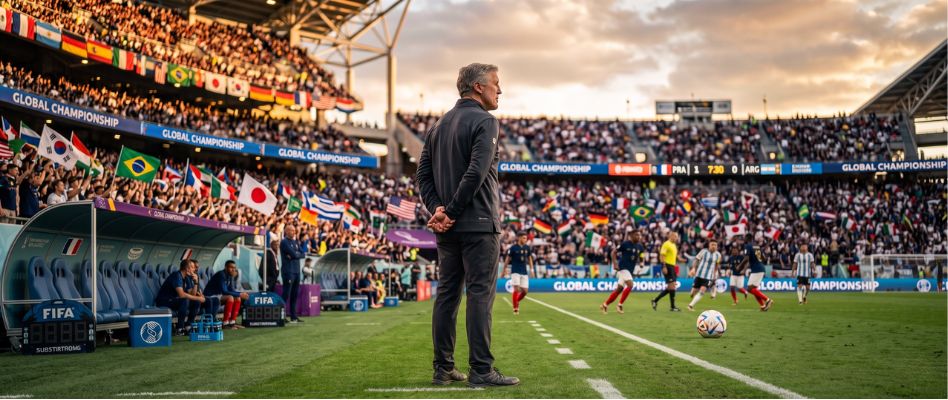
The World Cup doesn’t care about your budget. It doesn’t care how many people are on your staff or whether your competitors have fancier tools. Every four years, the best teams in the world step onto that pitch and prove something regional casino marketing directors already know in their bones: you don’t need the most resources. You need the right preparation.
The teams that win — the ones that shock the world — aren’t the ones with the biggest rosters.
TL;DR
Regional casino marketing teams don’t need bigger budgets to outperform their competitors — they need better preparation. This post draws on World Cup parallels to examine four disciplines that separate winning casino marketing teams from those that simply stay busy: coaching your team with intention, turning your calendar into a strategic formation, leveraging the small-market advantage, and knowing when to adjust a campaign before it’s too late. Three free tools are included to put each lesson into practice immediately.
They’re the ones with a coach who built a system, drilled the fundamentals, and ensured every player knew their role before the whistle blew.
Sound familiar?
Most regional casino marketing teams are working hard. The calendar is full. Offers go out. Events happen. But working hard and playing smart aren’t the same. The teams that consistently outperform their competitors — the ones that punch above their weight year after year — aren’t just doing more. They’re doing it with more intention, structure, and discipline. That’s why how you develop the people who run the operation matters so much.
That starts with how you develop the people who run the operation.
Your team may be small. Your budget may be tight. But right now, before the second half of 2026 kicks off, is the perfect time to stop winging it and start playing like a team that trained for this moment.
You’re Not Just a Marketing Director. You’re a Coach.
Watch any great World Cup coach on the sideline, and you’ll notice something. They’re not playing. They’re coaching others to play well under pressure.
That’s your job too.
The best casino marketing directors don’t just run campaigns. They build the people who run them. They see the gap between what their team can execute today and what they need to execute six months from now, and they deliberately close it.
But here’s what most marketing directors lack: a structured way to develop their team. Not another webinar they watch alone. Not a conference where everyone sits through sessions and comes home with a notebook full of ideas they never implement. They need a real training environment where their team gets coached, builds skills, and leaves with something they can use on Monday.

The coaching job starts with an honest assessment. Before you can develop your team, you need to know where they stand, not where you hope they are.
Ask yourself these five questions:
- Does my team understand why we run the promotions we run, or just how to execute them?
- Can anyone on my team explain how a campaign relates to guest behavior?
- If I asked my team to build next year’s calendar from scratch, could they justify every decision?
- Do we debrief after campaigns or just move on to the next one?
- Is my team learning in a structured way, or picking things up as they go along?
If the honest answer to most of those questions is “no” or “I’m not sure,” that’s not a team problem. That’s a coaching opportunity. This is exactly the kind of gap that widens the longer you wait to address it.
FREE DOWNLOAD
Marketing Team Pulse Check
Five questions. Honest answers only. Know where your team truly stands — and use it anytime.
A Marketing Calendar Isn’t a Strategy. A Formation Is.
Every World Cup team takes the field with a formation. 4-3-3. 4-4-2. 3-5-2. The formation isn’t just about positions. It’s a deliberate decision about how to win, based on your strengths, your opponents, and your objectives.
A marketing calendar full of promotions isn’t a formation. It’s a list.
There’s a difference between a calendar that fills space and one that gets work done. A real formation tells you where every promotion belongs, what it’s designed to accomplish, which guest segments it’s built for, and how you’ll know whether it worked. That’s what separates planning from strategy.
Most regional casino marketing teams are building calendars. The best are building formations.

The difference isn’t the number of programs on the calendar. It’s whether every item on that calendar can answer four questions before it goes live:
- Does this program have a clearly defined guest segment it’s intended to reach?
- Do we know in advance what behavioral outcome we’re trying to drive, not just what we’re offering?
- Does this initiative fit into a sequence that builds momentum, or is it just another disconnected event?
- Can we tell the difference between what’s on this calendar because it works and what’s there because it’s always been there?
If you can’t answer all four questions with confidence, your calendar is just a list. The good news is that it’s fixable. Start by running every item on your next calendar through those four questions before it’s approved. Items that can’t answer them don’t belong on the calendar yet.
FREE DOWNLOAD
Casino Marketing Calendar Worksheet
A monthly planning template that transforms your marketing calendar from a schedule into a strategy.
The Regional Casino Advantage No Budget Can Buy
Some of the greatest moments in World Cup history come from teams nobody expected to win. Morocco taking down Spain and Portugal in 2022. Croatia consistently crashing the podium despite having a fraction of the resources of the giants they beat. Senegal making the world stop and pay attention.
They didn’t win on budget. They won on preparation, discipline, and a game plan built around their specific strengths, not a blueprint lifted from someone else’s playbook.
You don’t need to follow soccer to understand this story. St. Louis Cardinals fans have lived it for decades. Eleven World Series titles. A payroll that’s rarely come close to those of the marquee teams in the league. What the Cardinals have built isn’t luck. It’s a system. A culture of development, discipline, and organizational clarity that consistently outperforms teams that simply spend more.
That’s not an accident. That’s a philosophy.
What does that kind of system look like in practice? It looks like a team that understands why every decision is made, not just how to execute it. It looks like a marketing calendar built around guest behavior, not just available dates. It looks like a director who has trained her team to ask better questions — about segments, outcomes, and what the data is actually saying — before a single promotion goes live.
That kind of discipline doesn’t require a huge budget. It requires a commitment to deliberately building it.
Your regional casino has the same opportunity.
The competitor down the road may have a bigger marketing budget and a larger team. But they don’t have your community relationships. They don’t have your regulars’ loyalty. And they almost certainly don’t have a team trained to turn those advantages into a smarter, more disciplined marketing operation.
The regional market is your home pitch. You know the crowd and the conditions. What you need is the preparation to play your best game there and the discipline to stop borrowing plays from properties that don’t look anything like yours.
Key Takeaways
- The best casino marketing directors don’t just run campaigns. They develop the people who run them, and that starts with an honest assessment of where the team actually stands.
- A marketing calendar full of promotions is not a strategy. Every initiative should have a named guest segment, a behavioral outcome, and a measurement plan before it goes on the calendar.
- Regional casinos have a built-in competitive advantage — community relationships, local loyalty, and market knowledge — that bigger-budget competitors can’t replicate. The gap is in preparation, not resources.
- Mid-campaign adjustment is a skill, not a failure. Three signals tell you when it’s time to change course: below-baseline response, the wrong guests responding, and floor team feedback that something feels off.
- The difference between a team that wings it and a team that wins is preparation — built deliberately, before the season starts.
- Three free downloads support the lessons in this post: the Marketing Team Pulse Check, the Casino Marketing Calendar Worksheet, and the Mid-Campaign Decision Playbook.
Know When to Make the Substitution
The best World Cup coaches don’t stick with a losing strategy out of habit. They read the game. They make halftime adjustments. They pull a player who isn’t performing, not as punishment, but because the game demands something different.
Mid-campaign pivots are among the most underused skills in casino marketing. Most teams run a promotion, watch it underperform, and wait until it’s over to decide what went wrong. But a good coach doesn’t wait for the final whistle to make a change.
The problem isn’t that teams don’t want to adjust. It’s that they don’t know when to. They second-guess themselves, tell themselves there’s still time, and hope the numbers turn around.
They don’t always turn around.
The teams that consistently finish strong have learned to read three signals that tell them — before it’s too late — that a change is needed:
- Response is significantly below your baseline at the midpoint. If you’re halfway through the campaign window and at less than 40–50% of your expected response, the campaign is not on track. Don’t wait for the final number to confirm what the midpoint already shows.
- The wrong guests are responding. Activity isn’t always a good sign. If low-value guests are driving most of your redemptions, or your acquisition promotion is attracting one-and-done visitors, you have a behavioral problem, not a participation problem. More volume won’t fix it.
- Your team is telling you something feels off. Your floor staff, dealers, and host team see guest reactions in real time. If they say guests seem confused, uninterested, or unaware that the campaign is running, that’s data, not anecdote. Data.
Seeing two or more of those signals? That’s your halftime whistle. The question isn’t whether to adjust — it’s knowing exactly what to do next.
FREE DOWNLOAD
Mid-Campaign Decision Playbook
Ten scenarios. Step-by-step response sequences. Use it before it’s too late to matter.
The Tournament Is Won in Training
Here’s the part that doesn’t make the highlight reel: every team at the World Cup spent months preparing before a single match was played. The goals that look effortless on television are the result of thousands of hours of deliberate practice, coaching, and drilling fundamentals until they become instinct.
The second half of 2026 is approaching. The 2027 planning season is closer than it seems. Right now — before the calendar fills up, before the next promotion goes out, and before the next GM meeting where someone asks whether marketing is actually driving visits — is the time to get your team trained.
Not trained in the sense of sitting through a presentation. Trained in the sense of building something real, being coached through difficult decisions, and leaving with the tools, frameworks, and confidence to play smarter.
The difference between a team that wings it and a team that wins isn’t necessarily talent. It’s preparation. It’s having a coach who knows how to develop people, a formation that turns the calendar into a strategy, and the discipline to read the signals and adjust before it’s too late.
Those aren’t things you figure out midseason. They’re things you build before the whistle blows.
The whistle is going to blow whether your team is ready or not. Make sure they are.
FAQs
What does it mean to build a casino marketing formation instead of a calendar?
A casino marketing formation is a strategic framework that gives every promotion, event, and campaign a purpose before it goes live. Unlike a traditional marketing calendar — which is essentially a schedule of activities — a formation requires each initiative to have a defined guest segment, a behavioral outcome, and a way to measure success. If an item on your calendar can’t answer those questions, it doesn’t belong there yet.
How do regional casinos compete against larger properties with bigger marketing budgets?
Regional casinos compete on preparation, discipline, and local advantage — not budget. Properties like the St. Louis Cardinals demonstrate that consistent outperformance doesn’t require the largest payroll. It requires a system: a team trained to make better decisions, a calendar built around guest behavior, and the discipline to stop borrowing strategies from properties that don’t look anything like yours. Community relationships and local loyalty are genuine competitive advantages that bigger-budget competitors can’t replicate.
What are the signs that a casino marketing campaign needs to be adjusted mid-flight?
Three signals indicate a mid-campaign adjustment is needed: response rate is significantly below your baseline at the midpoint (less than 40–50% of expected response), the wrong guests are responding (low-worth or one-and-done visitors rather than your target segment), and your floor team is reporting that guests seem confused, uninterested, or unaware the campaign is running. Two or more of these signals together mean it’s time to act, not wait.
How should a casino marketing director assess their team’s readiness?
Start with five honest questions: Does your team understand why you run the promotions you run, or just how to execute them? Can anyone explain how a campaign connects to guest behavior? If asked to build next year’s calendar from scratch, could they justify every decision? Do you debrief after campaigns? Is your team learning in a structured way or picking things up as they go? The Marketing Team Pulse Check (free download) walks through this assessment in ten minutes.
What is the difference between a casino marketing team that’s busy and one that’s winning?
A busy casino marketing team measures success by outputs — emails sent, events executed, promotions launched. A winning team measures success by outcomes — guest behavior changed, trip frequency increased, worth shifted, reinvestment working harder. The shift from busy to winning starts with how the director develops the team, how the calendar is built, and whether mid-campaign decisions are made with data or delayed out of habit.
What tools can casino marketing directors use to build smarter campaigns?
Three free resources support the disciplines covered in this post. The Marketing Team Pulse Check is a ten-minute assessment that identifies where a team’s capability gaps actually are. The Casino Marketing Calendar Worksheet is a monthly planning template that ensures every initiative has a guest segment, behavioral outcome, and success metric before it’s approved. The Mid-Campaign Decision Playbook covers ten common scenarios where casino marketing campaigns underperform mid-flight, with step-by-step response sequences for each.
Recent Comments